
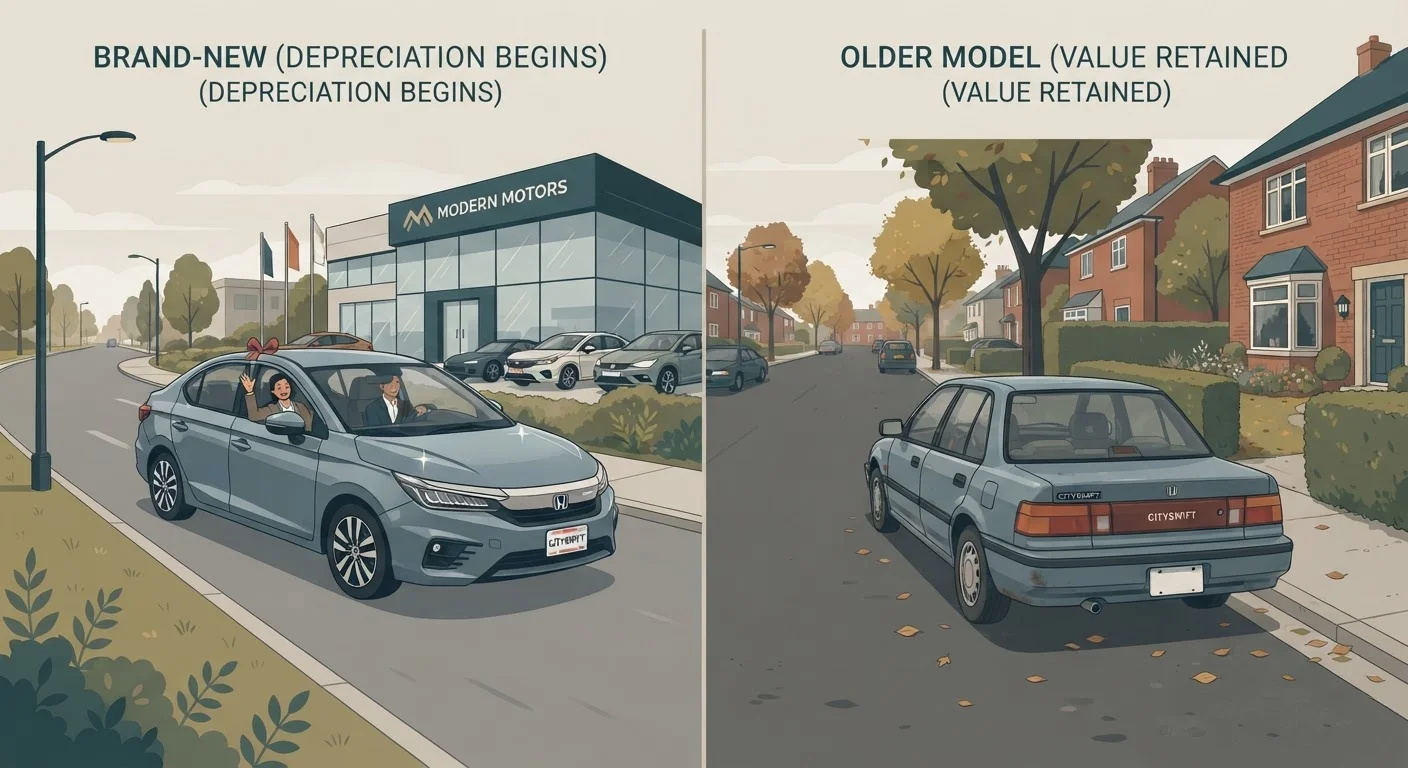
What depreciation actually means for your wallet
Most car owners focus on the monthly payment. The larger, quieter cost is the value draining out of the vehicle while it sits in the driveway. Depreciation is that cost, and for a typical new car purchase, it exceeds what owners spend on fuel or insurance over the same period.
Consider a vehicle purchased for $35,000. If it retains 45 percent of its value after five years, the owner has absorbed roughly $19,250 in lost value. That works out to about $320 per month, before financing costs, insurance, or a drop of fuel. See how depreciation fits into total ownership cost for a fuller picture of what a vehicle actually costs over its lifetime.
The loss is not evenly distributed. A new vehicle loses a disproportionate share of its value in year one, with the rate slowing as the car ages. This front-loaded curve is what makes early trade-ins particularly costly.
15-25%
New car value lost in year one
Industry resale data consistently shows most new vehicles lose between 15 and 25 percent of purchase price within the first twelve months.
~40-60%
Value lost after five years
Many new vehicles retain only 40 to 60 percent of their original purchase price after five years, with significant variation by make, model, and condition.
$320+
Estimated monthly depreciation cost
On a $35,000 vehicle depreciating to 45% of value over five years, the monthly depreciation cost alone exceeds $300 before any other ownership expense.
The factors that accelerate value loss
Several factors push a car down the depreciation curve faster than average.
- Mileage. Lenders and private buyers use annual mileage as a proxy for mechanical wear. Exceeding roughly 12,000 to 15,000 miles per year is generally considered high usage and reduces offer prices accordingly.
- Condition and accident history. A reported collision, even a repaired one, can cut resale value by 10 to 25 percent compared with a clean-history vehicle of the same year and trim.
- Color. Unusual or polarizing colors limit the pool of willing buyers. White, silver, gray, and black consistently show stronger resale demand in the U.S. market.
- Category shifts. Sedans have depreciated faster than trucks and SUVs over the past decade as buyer preferences shifted. A vehicle category falling out of favor depreciates faster regardless of the individual car's condition.
- Fuel type transitions. As electric vehicles grow their market share, some gasoline models in certain segments face increased depreciation pressure, though the effect varies widely by segment and region.
Missing scheduled maintenance also accelerates perceived value loss. A buyer who cannot verify oil changes, fluid flushes, and tire rotations will discount their offer to cover assumed risk. Consistent maintenance habits protect both the vehicle and its resale position.
How buying decisions change your depreciation exposure
When you buy determines how much depreciation you absorb. A buyer who purchases a one- to three-year-old vehicle lets the original owner absorb the steepest part of the curve. The used buyer may pay 20 to 35 percent less than the original sticker price and face a shallower depreciation slope going forward.
The financial trade-offs of buying used are real on both sides: lower depreciation exposure versus higher potential maintenance costs. Neither choice is universally better; the math depends on the specific vehicle, its history, and how long you plan to keep it.
How long you hold a vehicle also matters. Owners who keep a car for eight to ten years spread the early depreciation hit across more months of use, reducing its effective per-month cost. Frequent trading, by contrast, repeatedly resets the ownership cycle at the point of maximum depreciation. This pattern is one mechanism behind expensive car ownership cycles that quietly drain family budgets over time.
Negative equity and trade-ins
If you owe more on a car loan than the vehicle is currently worth, you are in a negative equity position (sometimes called being 'underwater'). Trading in at this point means rolling the remaining balance into the next loan, which compounds the cost of depreciation across multiple vehicles. This is general information; a licensed financial adviser can help you evaluate your specific loan and equity situation.
What you can do to limit the damage
Depreciation cannot be eliminated, but it can be managed. A few concrete habits make a measurable difference at resale time.
- Keep a maintenance log with dates, mileage, and receipts. Documentation converts ambiguity into verifiable history, which buyers pay for.
- Address minor cosmetic damage (chips, small dents) before selling. Buyers use visible wear to anchor lower offers, often discounting more than the repair would cost.
- Stay close to average annual mileage where your situation allows. Each additional 10,000 miles per year above average typically reduces trade-in offers by several hundred to a few thousand dollars depending on the vehicle.
- Choose colors and trim levels with broad appeal if resale value matters. Rare configurations take longer to sell and attract narrower buyer pools.
- Factor depreciation into the purchase decision itself. Vehicles with historically strong residual values cost more to buy but return more at sale, which can make the net ownership cost competitive or lower.
This article is general educational information, not financial or investment advice. For decisions specific to your financial situation, consulting a qualified professional is the appropriate step.