
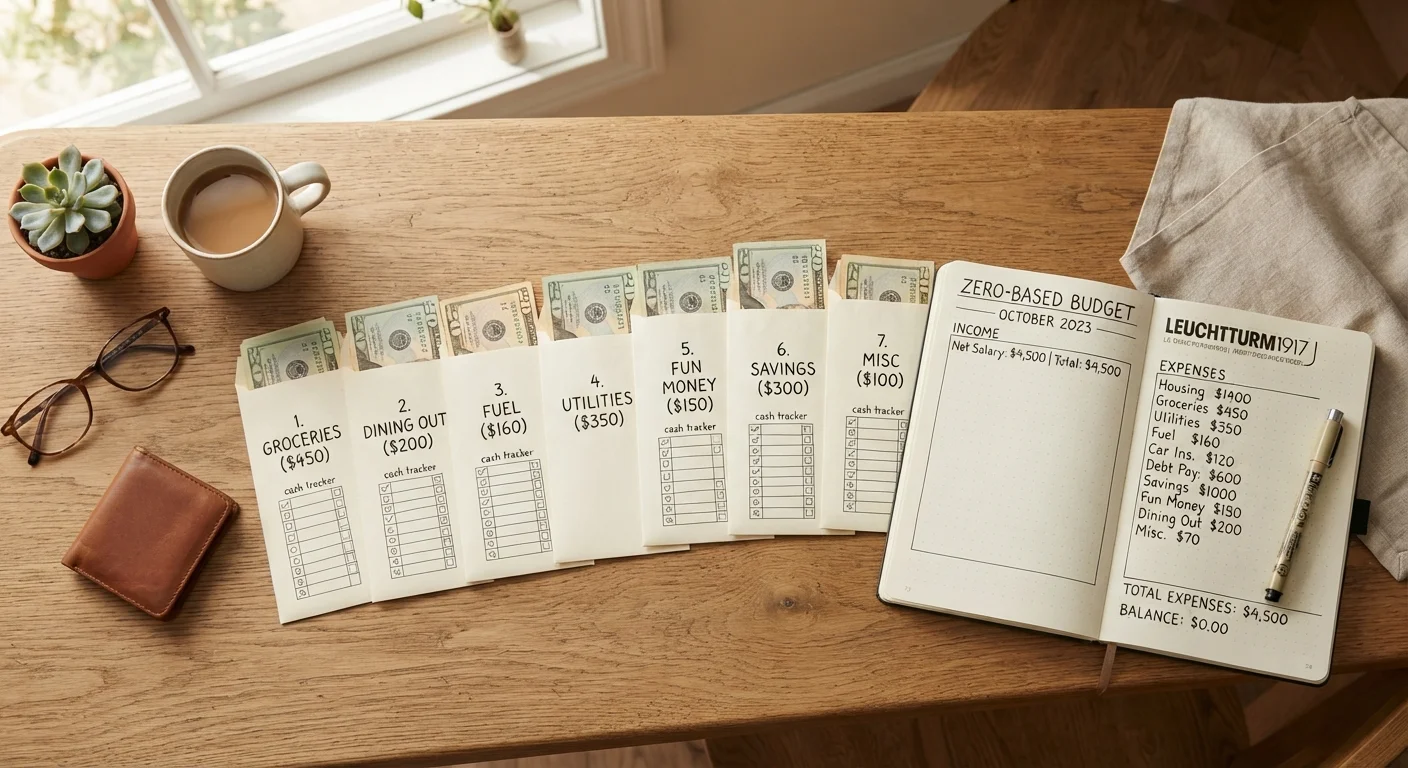
How envelope budgeting works
Envelope budgeting divides your take-home pay into labeled spending categories, with a set dollar amount in each. Historically, families used physical cash envelopes labeled "groceries," "gas," or "clothing." When the money in an envelope ran out, spending in that category stopped until the next pay period.
Digital versions of the same idea exist today. Some households use separate accounts or apps that mimic envelope logic without handling cash. The core mechanic stays the same: a hard ceiling per category, visible in real time.
The method works best for variable expenses, the costs that change month to month. For fixed bills like rent or a car payment, an envelope adds little because the amount is already set. Understanding which of your costs are fixed versus variable matters before you build any budget. The guide to fixed and variable expenses covers that distinction in plain terms.
One common adjustment: when one envelope runs low, some families borrow from another. That flexibility can be practical, but it also erodes the system if it becomes a habit rather than an exception.
Start with your three biggest variable categories
If envelope budgeting feels overwhelming at first, limit it to the two or three spending areas where your household most often goes over. Groceries, dining out, and entertainment are common culprits. Getting control of those three can free up money without requiring you to track every dollar at once.
How zero-based budgeting works
Zero-based budgeting starts from your total monthly income and assigns a purpose to every dollar until the running total reaches zero. The zero does not mean you spend everything. A dollar assigned to savings still counts as "spent" in the plan because it has a destination.
At the start of each month, you list income, then list every expected expense and savings contribution. Categories adjust to match what that specific month requires: higher utilities in winter, back-to-school costs in August, a car registration fee in October. The plan changes each month because life does.
This approach gives a complete view of household cash flow, which helps families see where money goes and decide whether those amounts match their actual priorities. That connects directly to the idea of spending with purpose, separating needs from wants before the money moves.
The trade-off is time. Building a fresh plan each month takes more effort than topping up envelopes. Households with predictable incomes and regular bills often find the process faster once they have a template from prior months.
Side-by-side comparison
The table below compares both methods across practical criteria so you can see where they differ at a glance.
| Envelope budgeting | Zero-based budgeting | |
|---|---|---|
| Core mechanic | Cash or virtual caps per category | Assign every dollar a destination |
| Monthly setup time | Low to moderate | Moderate to high |
| Works well with irregular income | Less flexible | Adjusts each month |
| Spending visibility | Per-category only | Whole household picture |
| Best for | Containing specific overspending | Full cash-flow awareness |
| Learning curve | Low; intuitive system | Steeper; requires full inventory |
| Savings handling | Separate envelope or account | Built into the monthly plan |
Choosing the approach that fits your household
A few questions can narrow the choice. Do you overspend in specific categories but feel generally in control elsewhere? Envelope budgeting targets those weak spots without requiring a full financial overhaul. Do you feel uncertain about where your money goes at all? Zero-based budgeting forces you to map everything, which can surface spending patterns that surprise you.
Income variability also matters. Freelancers and gig workers often find zero-based budgeting more useful because the monthly plan adjusts to actual income rather than an assumed fixed amount. A salaried household with stable bills can use either method with similar results.
Some families try a hybrid: zero-based planning at the start of the month to set overall allocations, then envelope mechanics for the categories most prone to creep. That combination adds some complexity but gives tighter control where it matters most.
Whichever method you choose, a monthly review is necessary. The monthly money reset checklist walks through the steps for reviewing spending, tracking bills, and preparing for irregular costs in the month ahead. Both budgeting systems benefit from that kind of regular check-in.
This article is for general informational and educational purposes only and does not constitute personalized financial advice. Consult a qualified financial professional for guidance specific to your household's situation.