
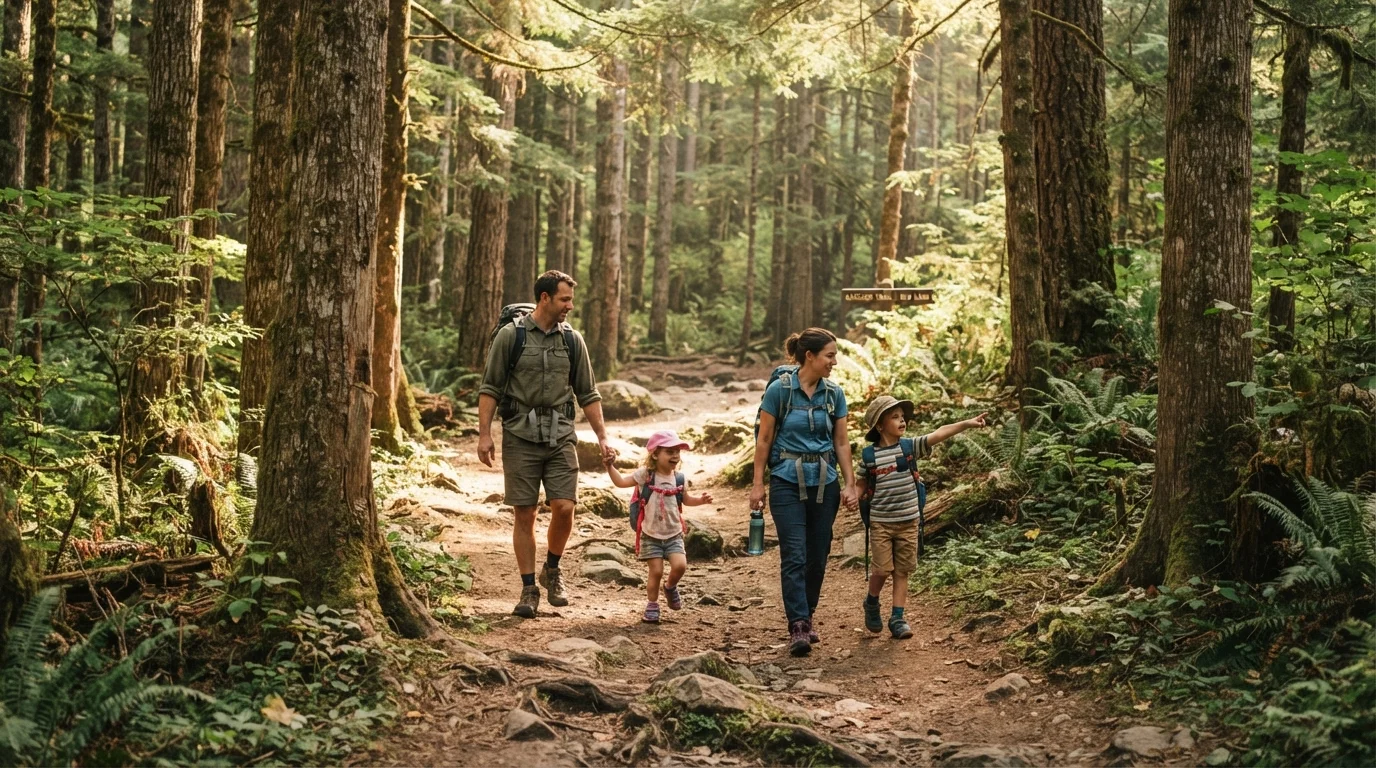
Making national parks work for your family budget
America's national parks cover more than 85 million acres and attract roughly 300 million visits each year. For families trying to travel without overspending, they represent one of the strongest value propositions in US travel: enormous natural spaces, organized programs, and educational content that costs far less than most commercial attractions.
The catch most families run into is assuming the entry fee is the only cost. Parking, camping, food, and gear can add up quickly if you do not plan ahead. See how hidden costs can quietly inflate a family trip before you book, and budget accordingly. This list focuses on activities that are either free at the point of use or low enough in cost to fit comfortably into a tight travel budget.
Use free entrance days throughout the year
The National Park Service designates several fee-free days each year. On these days, entrance fees are waived at all NPS sites, including high-traffic parks that normally charge up to $35 per vehicle. The dates typically include Martin Luther King Jr. Day, the first day of National Park Week in April, Juneteenth, the anniversary of the Great American Outdoors Act in August, and Veterans Day.
These dates are announced on the NPS website and do not change frequently, so they are easy to plan around. The trade-off is that popular parks see higher visitor volume on free days, so arriving early in the morning reduces wait times at entrance gates and trailheads.
Entrance fees are waived at all NPS sites on designated fee-free days, which occur several times a year.
Get the America the Beautiful pass
The Interagency Annual Pass, sold under the name America the Beautiful, costs $80 and covers entrance fees for the pass holder and up to three additional adults at over 2,000 federal recreation sites. Children under 16 enter free regardless. For a family visiting more than two or three parks in a year, this pass typically covers its cost within the first couple of visits.
Families with a fourth grader enrolled in school can get a free version of this pass through the Every Kid Outdoors program, which runs annually from September through August. Applications are completed online through the program's federal website, and the pass arrives by mail or can be exchanged for a physical card at a participating site.
Families with a fourth grader can get a free America the Beautiful pass through the Every Kid Outdoors program.
Attend ranger-led programs
Most national parks run free ranger-led programs daily during peak season and on weekends during shoulder months. These include guided walks, talks at amphitheaters, campfire programs, and themed presentations on geology, wildlife, or local history. The quality varies by park and ranger, but many of these programs are genuinely engaging for children who might otherwise lose interest on a self-guided visit.
Schedules are posted at visitor centers and on each park's NPS webpage. Some programs require advance registration due to limited group size, so checking the schedule a day or two before arrival is worth doing.
Free ranger-led programs run daily at most parks during peak season and cover everything from geology to wildlife.
Enroll kids in the Junior Ranger program
The Junior Ranger program is available at more than 400 NPS sites and costs nothing. Children pick up a booklet at the visitor center, complete a set of age-appropriate activities tied to the park's themes, and receive an official badge or patch when they return the completed booklet to a ranger. The activities typically involve short observation tasks, simple nature journaling, and questions that encourage kids to engage with what they see rather than just walk past it.
The program works well for children roughly between ages 5 and 12, though some parks have versions for older kids. It also gives the visit structure, which helps on longer days when fatigue sets in. Physical activity in natural settings at no cost is covered in more depth at free and low-cost ways families stay physically active.
The Junior Ranger program is free at more than 400 NPS sites and gives children a structured way to engage with each park.
Picnic instead of buying food inside the park
Food purchased at park concessions or gateway towns carries a significant markup. Packing a cooler with lunch, snacks, and drinks for the day eliminates this cost entirely. Nearly every national park has designated picnic areas with tables and restroom access, often in scenic spots that are themselves worth visiting.
The savings are straightforward: a family of four buying lunch at a park snack bar might spend $50 or more. The same meal packed from home costs a fraction of that. For families doing multiple park days in a row, this adds up to a meaningful reduction in trip spending without reducing the experience at all.
Packing a cooler and using free park picnic areas can save a family of four $50 or more per day on food.
Hike trails graded for families with young children
Trail conditions and difficulty vary widely across the national park system, and not every trail suits families with young or mixed-age children. The NPS website for each park lists trails by length, elevation gain, and difficulty rating. Many parks also have accessible paved paths near visitor centers that work for strollers and younger children.
Choosing trails matched to the slowest member of your group avoids the frustration and safety risk of turning back mid-route. Short loop trails in the 1 to 3 mile range with minimal elevation change are widely available at major parks including Acadia, Great Smoky Mountains, and Olympic. These trails cost nothing beyond park admission.
Short loop trails in the 1 to 3 mile range with minimal elevation are available free at most major national parks.
Watch for free wildlife viewing opportunities
Wildlife viewing is one of the most genuinely free activities in the national park system, and it is often the memory that sticks with children longest. Parks with reliable wildlife sightings include Grand Teton (bison, elk, pronghorn), Everglades (birds, alligators), and Denali (bears, caribou). No equipment is required, though binoculars improve the experience considerably and can be borrowed at some visitor centers.
Early morning and late afternoon are consistently the most active periods for large mammals. Staying on designated viewing areas and keeping safe distances is both required by park rules and important for safety. Rangers at entrance stations usually share current hotspots at no charge.
Early morning wildlife viewing costs nothing and is often the activity children remember most from a park visit.
Getting the most out of your park visit
Planning around what a park actually offers for free, rather than what its paid concessions promote, changes the experience considerably. Download the NPS app before you arrive: it has offline maps, ranger program schedules, and trail guides for most parks. Many visitor centers also stock free paper trail maps, which matter when cell signal drops.
If national parks fit into a broader road trip, pairing them with budget-friendly overnight options reduces the overall cost significantly. The trade-offs between camping and budget motels are worth thinking through before you commit to either. For families building a full route around public lands, road trip planning strategies for tight budgets cover the route and cost estimation groundwork that makes the whole trip sustainable.
Arrive early to avoid crowds and parking fees
Many popular national parks have implemented timed entry reservations during peak months. Check the specific park's NPS page well before your visit to see whether a reservation is needed, as showing up without one can mean being turned away at the gate. Arriving at or before the park's opening time also tends to secure free or lower-cost parking in main lots before they fill and paid overflow lots open.