
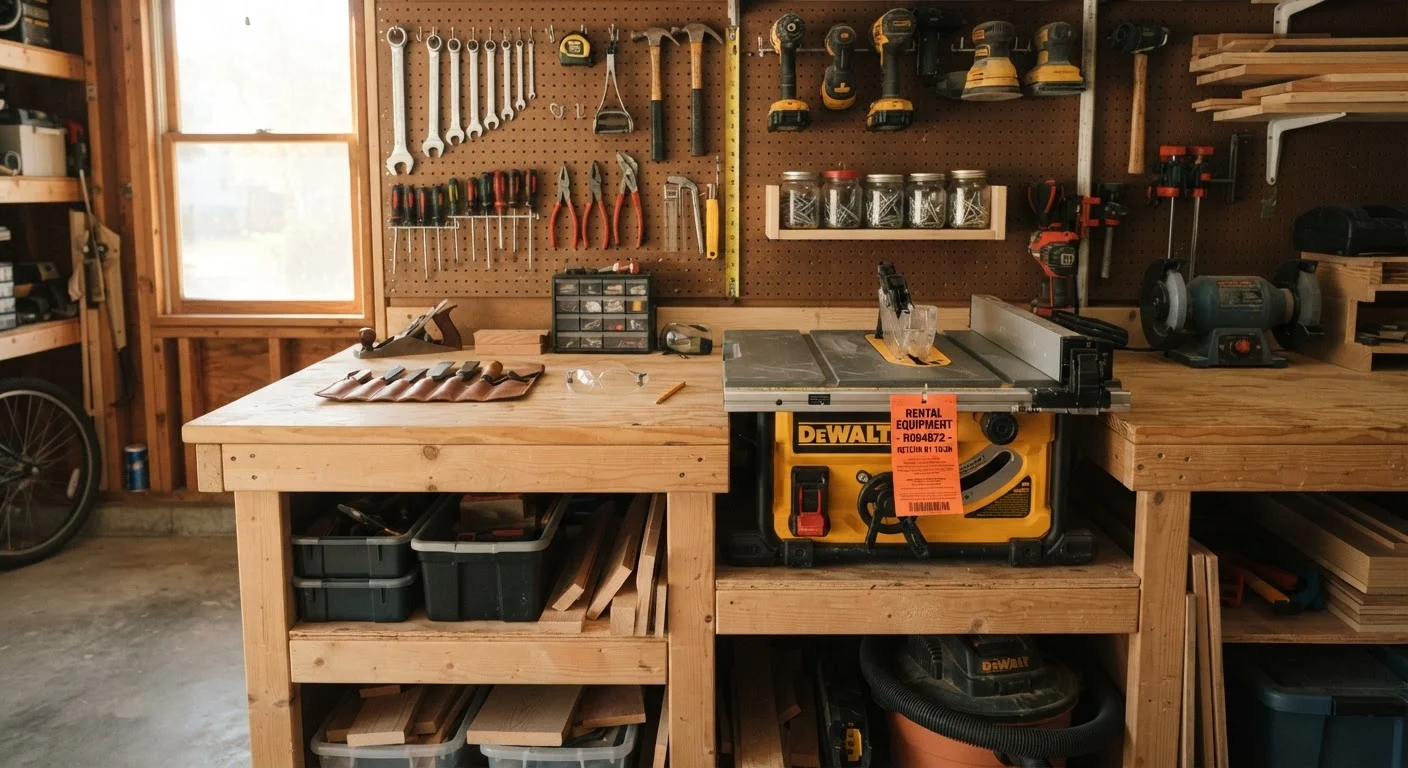
The core question: how often will you actually use it?
The single most reliable way to decide between renting and buying a tool is to estimate how many times you will use it over the next three years. If the answer is once or twice, renting almost always costs less. If the answer is eight or more times, ownership typically recovers its cost. Everything in between depends on the specific tool's price and its rental rate.
A mid-range tile saw, for example, might cost $300 to $500 to purchase and $60 to $90 per day to rent. A homeowner retiling one bathroom does not need to own that saw. But someone who plans to tile a bathroom, a mudroom, and a patio over three years will cross the break-even point after a few rentals and come out ahead by buying.
This arithmetic changes with tool category. Power hand tools like drills and sanders are relatively cheap to own, so the break-even point arrives after just a handful of uses. Heavy equipment like plate compactors, concrete mixers, or floor grinders carries a much higher purchase price, which pushes break-even further out and makes renting the reasonable default for most households. See common DIY misconceptions that affect spending for a look at how misjudging tool needs can inflate project costs.
What renting actually costs versus buying
| Criterion | Renting tools | Buying tools |
|---|---|---|
| Upfront cost | Low (daily or weekly rate) | Higher one-time purchase |
| Long-term cost (frequent use) | Adds up over multiple projects | Cost per use falls over time |
| Storage required | None | Garage or shed space needed |
| Maintenance responsibility | Rental center handles it | Owner handles blades, parts, upkeep |
| Access to specialty tools | Wide range available | Limited to what you purchase |
| Convenience | Requires pickup and return | Available immediately at home |
| Best for infrequent use | Yes | No, cost per use stays high |
Rental pricing varies by region and equipment type, but day rates for heavy power tools generally run $40 to $150 for common items like pressure washers, tile saws, and drain augers. Specialty equipment such as stump grinders, sod cutters, or drywall lifts can run $150 to $400 per day. Week-long rates are usually three to four times the daily rate, not seven times, which matters if a project stretches across several days.
Ownership costs include the purchase price plus consumables (blades, bits, belts), periodic maintenance, and storage. A cordless drill-driver set might cost $120 to $180 and last a decade with modest care. A corded circular saw in a similar price range is durable enough that the per-use cost drops below a dollar after regular use. These are tools worth owning. A 60-gallon air compressor at $400 or more is harder to justify unless you run pneumatic tools consistently.
The hidden costs most homeowners overlook
Storage is a real cost that rarely appears in a buy-versus-rent comparison. A floor sander, a tile wet saw, or a post-hole digger occupies garage or basement space that has value. Families with limited square footage pay that cost whether they account for it explicitly or not.
Maintenance is another factor. Owned tools need blades sharpened, motors blown clean, batteries replaced, and occasionally serviced. Rental centers handle that work on their inventory. When you rent, you receive a functioning tool and return it without any obligation for its upkeep.
Depreciation matters too. Power tools lose value over time whether used or not. A tool purchased for $250 may be worth $50 if sold secondhand several years later. That $200 depreciation is part of the ownership cost even if the tool never leaves the garage. {{link:/affordable-home-care/the-hidden-costs-of-skipping-routine-home-maintenance|Deferred home maintenance} often compounds costs in similar ways|Deferred home maintenance often compounds costs in similar ways}}, where small neglected items accumulate into larger bills.
On the rental side, the hidden cost is convenience friction. Picking up and returning equipment takes time. If a rental center closes at 6 p.m. and your project runs long, you may owe another day's fee. Factor that into the comparison before assuming rental is straightforwardly cheaper.
Tools worth buying versus tools worth renting
Most households benefit from owning a core set of versatile hand and power tools: a hammer, tape measure, level, cordless drill, circular saw, and a set of screwdrivers. These appear across dozens of project types, and their purchase price per use drops to negligible amounts over time.
The following categories are worth renting for most households:
- Floor refinishing equipment (drum sanders, edge sanders, floor buffers)
- Concrete and masonry tools (rotary hammers, concrete mixers, jackhammers)
- Landscaping equipment (stump grinders, sod cutters, aerators, trenchers)
- Specialty plumbing tools (drain snakes larger than 25 feet, pipe threaders)
- Drywall lifts and panel carriers for ceiling work
These tools are expensive to purchase, take up significant storage space, and most homeowners use them once every few years at most. Renting them as needed is straightforward and keeps money available for the materials that actually complete the job. For a broader view of how these decisions fit into overall household spending habits, separating needs from wants in your household budget offers a useful framework.